
Canine Teeth in Humans: Problems and Treatment in Seoul
What human canine teeth do, why they sometimes come in high, crooked or stay buried, and how they are corrected with orthodontics, bonding, veneers or crowns at our Gangnam clinic.
- Since 2002
- 13 dentists
- In-house lab
- EN · 中文 · 日本語
What do human canine teeth do, and how are canine problems fixed?
Human canines are the four long, pointed teeth at the corners of the mouth. They guide the jaw in side movements and protect back teeth. High, crooked or impacted canines are usually corrected with orthodontics, sometimes after minor surgery to expose a buried canine. At Gangnam One Day Dental Clinic, shape concerns can also be treated with bonding, veneers or crowns.
Reviewed by Dr. Kim Do-hoon , Chief Director, Orthodontics · Updated October 5, 2026
The role of canine teeth
Humans have four canines: one at each corner of the upper and lower arches. They have the longest roots of any teeth, which makes them strong anchors. When you slide your jaw sideways, the canines ideally take the load and lift the back teeth apart, a pattern called canine guidance.
Because of this, canines matter for bite function, not only appearance. Losing or wearing them down can shift load onto other teeth.
Common canine problems
Upper canines are among the last front teeth to erupt, usually around age 11 to 12, so they often run out of space. They may then come in high above the other teeth, sometimes called snaggletooth, or stay buried in the bone (impacted).
- High or crooked canines: usually due to crowding
- Impacted canines: stuck in bone, found on X-ray
- Very pointed canines: a shape concern
- Worn canines: often from grinding; see teeth grinding
Not sure if this is right for you? Send a photo or X-ray — a dentist replies on WhatsApp in English, Chinese or Japanese.
Get a free opinionTreatment options
High or crooked canines are aligned with orthodontics, usually fixed braces because canines have long roots and need controlled movement. An impacted canine may be uncovered with minor surgery and gently pulled into place with braces over many months. Our orthodontics department, led by Dr. Kim Do-hoon, plans these cases.
If the canine is well positioned but too pointed or worn, reshaping, composite bonding, veneers or a crown can change its shape without moving it.
| Usual treatment | Typical time | |
|---|---|---|
| High or crooked canine | Braces or selected aligners | 12–30 months |
| Impacted canine | Surgical exposure plus braces | Often 18–30 months |
| Pointed canine | Reshaping or bonding | 1 visit |
| Worn or broken canine | Bonding, veneer or crown | 1–3 visits |
How it works at Oneday Dental
- Before visit
Photos on WhatsApp
Send close-up photos of your canines and any X-rays.
- Visit 1
Examination
X-rays or 3D CT to locate impacted canines and check roots.
- Plan
Choose the approach
Orthodontic, surgical-orthodontic or cosmetic plan explained.
- Treatment
Align or reshape
Braces move the canine, or bonding/veneers change its shape.
- Finish
Retention and review
Retainers after orthodontics; bite checked for canine guidance.
Things to know before you decide
- Impacted canines can damage roots of neighbouring teeth if left untreated; X-rays assess this.
- Pulling an impacted canine into place takes time and is not always possible.
- Filing canines flat for cosmetic reasons can affect bite function.
- Veneers and crowns require tooth reduction in many cases.
- Adult impacted canines are harder to move than in teenagers.
Experience you can check
- 2002Founded in Gangnam — 24 years
- 13Dentists in 5 departments
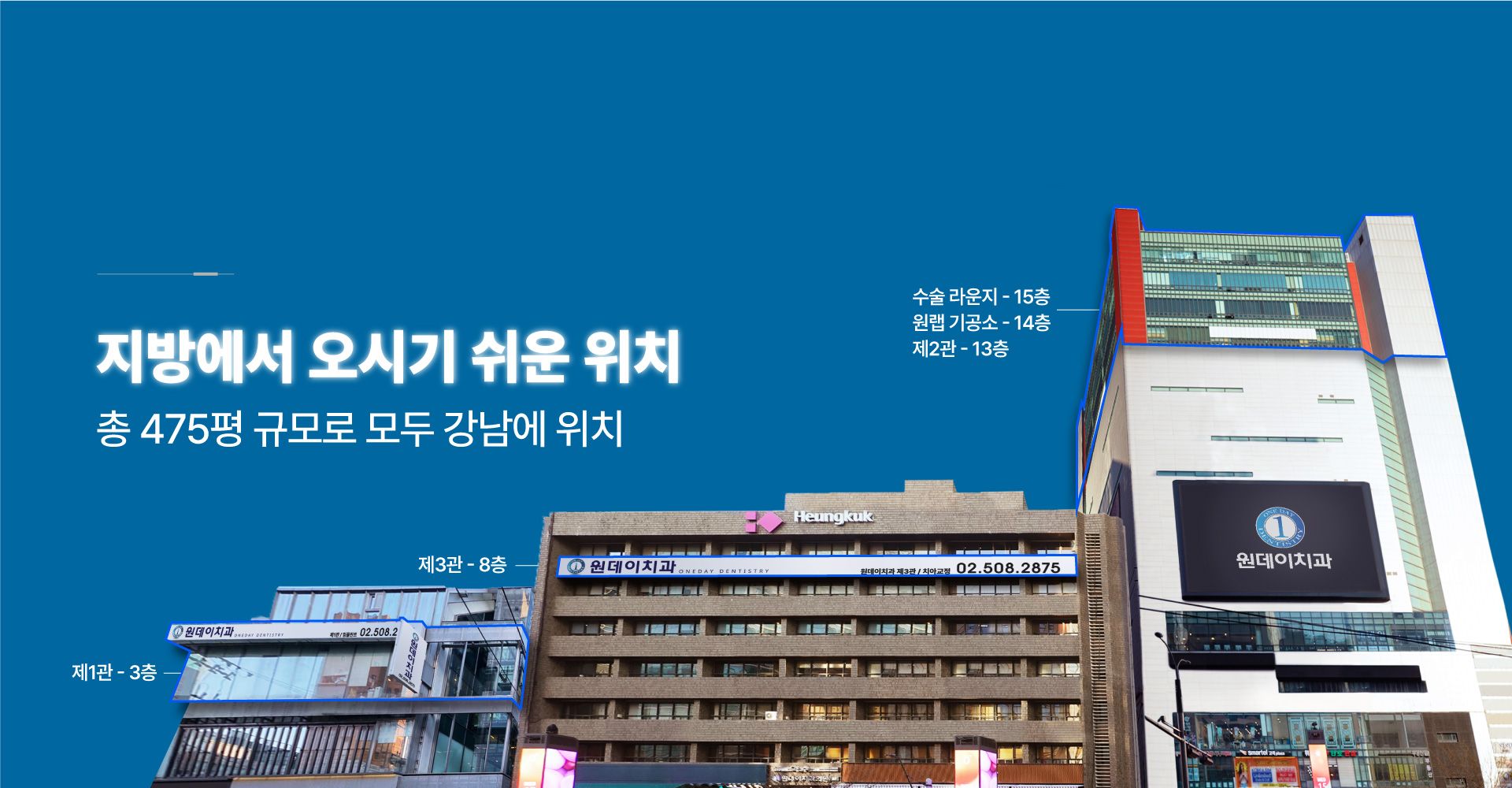
- 3Clinic buildings, 1,570 m²
- 0.01 mmT-Scan bite-force detail
Leads the orthodontics department (Building 3): braces, lingual, Invisalign & surgical orthodontics
Canine Teeth: common questions
Why are my canine teeth higher than my other teeth?
What is an impacted canine?
Can I file down pointed canine teeth?
Can clear aligners fix a high canine?
How much does canine teeth treatment cost in Seoul?
You may also want to read
Orthodontics in Seoul
Orthodontics in Seoul led by Dr. Kim Do-hoon: braces, Invisalign, clear aligners and protrusion correction…
Learn more →Metal Braces
Metal braces in Seoul for crowding, gaps and bite problems.
Learn more →Composite Bonding
Composite bonding in Seoul for chips, small gaps and uneven edges, usually in one visit with little or no drilling.
Learn more →Dental Veneers Seoul
Dental veneers in Seoul for visiting patients: prep, no-prep and one-day options made in our in-house Gangnam lab.
Learn more →Teeth Grinding & TMJ
Teeth grinding treatment in Seoul: T-Scan bite analysis, TMJ assessment and custom night guards led by an occlusion…
Learn more →Browse: Dental Implants · Cosmetic Dentistry · Orthodontics · Gum Care · General Dentistry · International Patients · Home
Get a dentist's opinion on WhatsApp
Send your question, photos or X-ray. We reply with a plan, timeline and estimate in English, Chinese, Japanese or Korean.