
Dental Bridges in Seoul
A fixed way to replace one to several missing teeth. We compare bridge types with implants honestly, then mill your bridge in our in-house lab in Gangnam.
- Since 2002
- 13 dentists
- In-house lab
- EN · 中文 · 日本語
What is a dental bridge?
A dental bridge is a fixed row of artificial teeth that fills a gap by attaching to supports on either side: crowned natural teeth or dental implants. It is cemented in place and not removed. Gangnam One Day Dental Clinic offers traditional, implant-supported, cantilever and Maryland bridges, designed by CAD/CAM in its in-house lab.
Reviewed by Dr. Kim Jin-hwan , Chief Director · Updated October 5, 2026
Four types of bridge
The best bridge for you depends on how many teeth are missing, where the gap is and the condition of the neighbouring teeth.
- Traditional bridge: crowns on the teeth either side support the false tooth.
- Implant-supported bridge: implants support the bridge, so neighbouring teeth are not cut.
- Cantilever bridge: supported on one side only; used in limited low-load areas.
- Maryland bridge: a thin wing bonded to the back of neighbouring teeth; minimal drilling, mainly for front teeth.
Bridge or implant?
A traditional bridge is faster and needs no surgery, but the neighbouring teeth must be shaped for crowns. If those teeth are healthy and unfilled, a single-tooth implant preserves them. If they already need crowns, a bridge can make sense.
For several missing teeth in a row, two implants can support a three- or four-unit bridge, reducing the number of implants needed.
Not sure if this is right for you? Send a photo or X-ray — a dentist replies on WhatsApp in English, Chinese or Japanese.
Get a free opinionMade and checked in-house
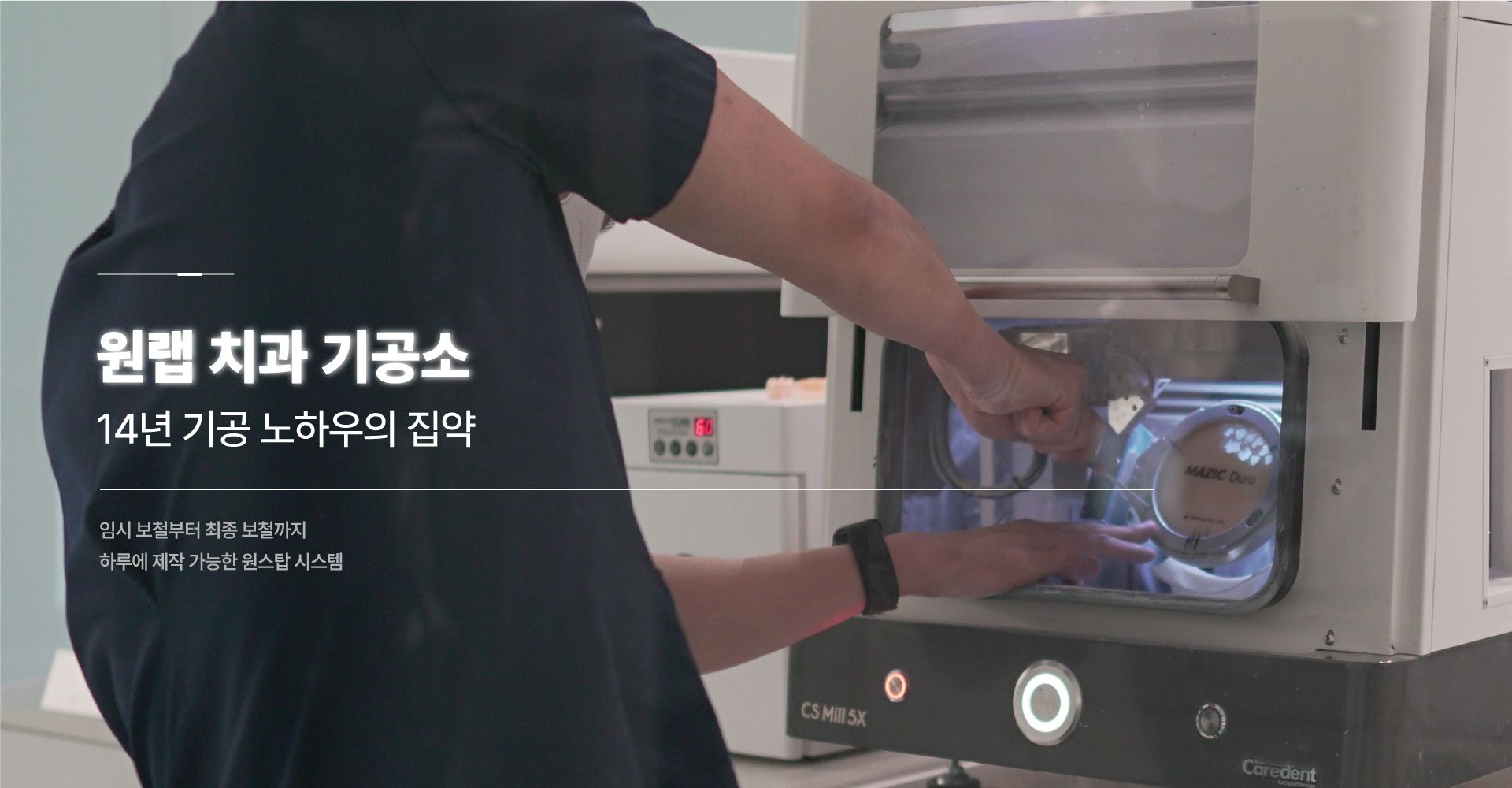
Bridges are designed from intraoral scans and milled by CAD/CAM in Oneday Lab, our in-house lab. Temporary to final prosthetics can be made in one day for suitable cases, which helps visitors on short trips.
Because a bridge links several teeth, an uneven bite stresses all of them. We can check contacts with T-Scan Novus digital occlusion analysis.
| Traditional | Implant-supported | Maryland | |
|---|---|---|---|
| Neighbouring teeth | Shaped for crowns | Not touched | Minimal preparation |
| Surgery | No | Yes | No |
| Time to final | Usually 1–2 weeks | Usually 3–6 months | Usually 1–2 weeks |
| Best for | Gap with crowned neighbours | Multiple missing teeth | Single front tooth |
| Bone under gap | Continues to shrink | Implants help preserve | Continues to shrink |
How it works at Oneday Dental
- Visit 1
Exam and options
X-rays, scan and a comparison of bridge versus implant options with confirmed costs.
- Visit 1
Preparation
Supporting teeth are shaped under local anaesthesia and scanned; a temporary bridge is fitted.
- 1–7 days
Lab fabrication
The bridge is designed and milled in Oneday Lab.
- Visit 2
Fitting
Fit, shade and bite are checked before the bridge is cemented.
Things to know before you decide
- Supporting teeth are permanently reshaped for a traditional bridge.
- Decay can develop under bridge crowns if the area under the false tooth is not cleaned daily.
- Cantilever and Maryland bridges are not suitable for heavy-biting back teeth in most cases.
- Weak or gum-diseased supporting teeth may not be able to carry a bridge.
Experience you can check
- 2002Founded in Gangnam — 24 years
- 13Dentists in 5 departments
- 3Clinic buildings, 1,570 m²
- 0.01 mmT-Scan bite-force detail
Vice President, Korean Academy of Stomatognathic Function & Occlusion · author on T-Scan implant occlusion (IGI Global)
Dental Bridges: common questions
How long does a dental bridge last?
Can I get a bridge in one trip to Seoul?
Is getting a bridge painful?
How much does a dental bridge cost?
Bridge or partial denture?
You may also want to read
Dental Crowns
Dental crowns in Gangnam, Seoul: zirconia and all-ceramic crowns milled in our in-house lab, often in one day.
Learn more →Single-Tooth Implant
Single tooth implant in Korea: implant vs bridge compared, OSSTEM or MegaGen, crown made in our Gangnam lab.
Learn more →Dental Implants
Dental implants in Seoul with OSSTEM or MegaGen, 3D CT planning and an in-house lab in Gangnam since 2002.
Learn more →Dentures
Dentures in Gangnam, Seoul: complete, partial, immediate and implant-supported, digitally designed in our in-house…
Learn more →Implant Cost
Dental implant cost in Korea: 2026 guide prices from ₩1,000,000 per tooth, what is included and what changes it.
Learn more →Browse: Dental Implants · Cosmetic Dentistry · Orthodontics · Gum Care · General Dentistry · International Patients · Home
Get a dentist's opinion on WhatsApp
Send your question, photos or X-ray. We reply with a plan, timeline and estimate in English, Chinese, Japanese or Korean.