Orthodontics in Seoul
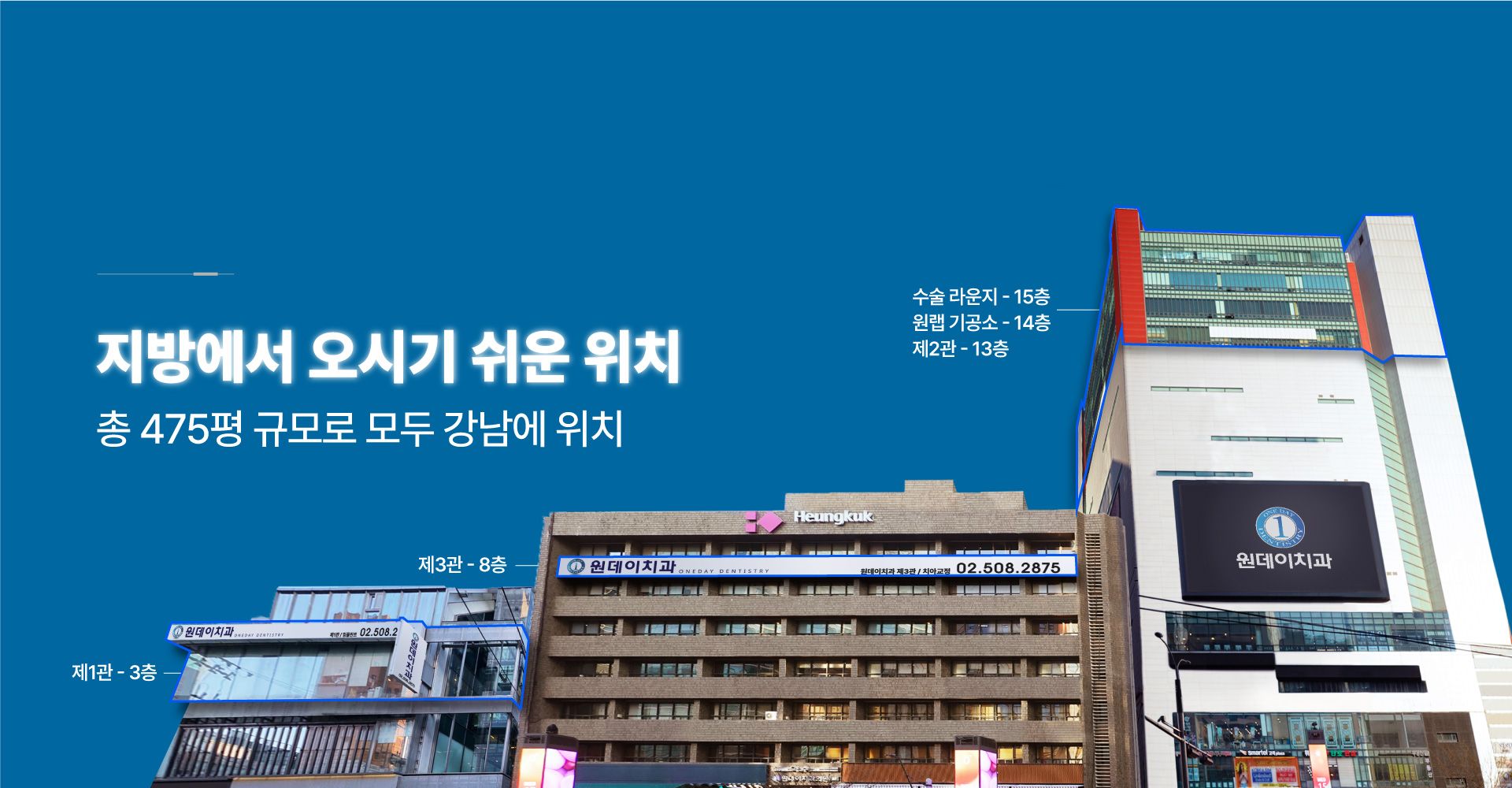
Braces, clear aligners and protrusion correction from a dedicated orthodontic department in Gangnam, led by Dr. Kim Do-hoon on the 8th floor of our Building 3 at 442 Gangnam-daero.
- Since 2002
- 13 dentists
- In-house lab
- EN · 中文 · 日本語
Where can I get orthodontic treatment in Seoul?
Gangnam One Day Dental Clinic has a dedicated orthodontic department in Gangnam, Seoul, led by Dr. Kim Do-hoon at the Heungkuk Fire Insurance Building 8F, 442 Gangnam-daero. Options include metal braces, self-ligating Clippy-C braces, lingual braces, Invisalign and other clear aligners, and protrusion and surgical orthodontics. Most comprehensive cases take about 12 to 30 months, confirmed after examination.
Reviewed by Dr. Kim Do-hoon , Chief Director, Orthodontics · Updated October 5, 2026
One orthodontic department, every main appliance type
Orthodontics at Gangnam One Day Dental Clinic is a separate department, not a side service. It sits in our third building, the Heungkuk Fire Insurance Building 8F at 442 Gangnam-daero, Yeoksam-dong. Dr. Kim Do-hoon, Chief Director of Orthodontics, leads general, lingual, clear aligner and Invisalign treatment, protrusion correction and surgical orthodontics.
Because one team offers fixed braces and aligners, the appliance is chosen for your bite, not the other way round. How teeth move and how each appliance type compares are explained below.
- Fixed braces: metal braces and self-ligating Clippy-C braces
- Hidden or removable: lingual braces, Invisalign and other clear aligners
- Bite and profile: overbite, buck teeth, protrusion and surgical orthodontics
- Children: children's orthodontics within our family dentistry
How teeth actually move
Each tooth sits in bone, held by a thin ligament. When a brace or aligner presses gently on a tooth, bone on the pressure side is resorbed and new bone forms on the other side. The tooth travels with it, usually at around 1 mm per month.
This is why orthodontics cannot be rushed. Heavy force does not speed it up; it raises the risk of root shortening and gum problems. Planned, light force is safer and more predictable.
Not sure if this is right for you? Send a photo or X-ray — a dentist replies on WhatsApp in English, Chinese or Japanese.
Get a free opinionThe main types of orthodontic appliance
All appliances use the same biology. They differ in visibility, control, comfort and how much the patient has to do.
- Metal braces: brackets and wires; the widest control for complex movement. See metal braces.
- Self-ligating braces: brackets with a built-in clip instead of elastic ties, such as Clippy-C braces.
- Lingual braces: brackets bonded behind the teeth, hidden from view.
- Clear aligners: a series of removable trays worn 20–22 hours a day, such as Invisalign.
- Retainers: fixed wires or removable trays that hold results after treatment.
Which problems orthodontics can correct
Orthodontics moves teeth slowly through the bone with light, steady force. It treats crowding, gaps, rotated teeth, deep bites, open bites, crossbites and forward-flared front teeth. Where the jaw itself is the cause, orthodontics may be combined with jaw surgery, which Dr. Kim Do-hoon plans as surgical orthodontics.
Many adults come to us for protruding front teeth. Our page on protruding front teeth explains when extraction space is needed and when it is not.
Planning starts with records, not a sales quote
A plan needs X-rays, photos and an intraoral scan or impressions. From these the orthodontist measures tooth position, jaw relationship and available space before suggesting an appliance and a time frame.
You can start on WhatsApp by sending clear smile photos and any recent X-rays. The team replies in English, Chinese, Japanese or Korean with which options look realistic and what the in-person examination will confirm.
Signs you may benefit from orthodontics
Orthodontics is not only cosmetic. Crowded teeth are harder to clean, and a poor bite can wear teeth unevenly or overload certain teeth. Common reasons people seek treatment include crowding, gaps, a deep bite, buck teeth, crossbite and front teeth that flare forward.
Not every concern needs braces. Small chips or shape issues may be better solved with bonding or veneers, and the orthodontist will tell you when tooth movement is not the right tool.
| Metal / Clippy-C braces | Lingual braces | Clear aligners | |
|---|---|---|---|
| Visibility | Visible on front | Hidden behind teeth | Nearly invisible |
| Removable | No | No | Yes, 20–22 h/day wear |
| Case range | Simple to complex | Most cases | Mild to moderate, selected complex |
| Typical duration | 18–30 months | 18–30 months | 6–24 months |
| Check-ups | Every 4–8 weeks | Every 4–8 weeks | Every 6–10 weeks |
Explore orthodontics treatments
Braces Cost Guide
Affordable braces in Seoul: what drives orthodontic cost, which option is usually cheapest, and hidden extras to…
Learn more →Buck Teeth Treatment
Buck teeth treatment in Seoul: why upper front teeth stick out, braces vs aligners vs veneers, and realistic…
Learn more →Canine Teeth
Human canine teeth explained: their role, high or impacted canines, and fixes from orthodontics to bonding in Seoul.
Learn more →Clear Aligners
Clear aligners in Seoul for residents: how removable trays straighten teeth, who suits them and how they compare…
Learn more →Clippy-C Braces
Clippy-C self-ligating braces in Seoul: built-in clip brackets with no elastic ties, easier cleaning and fewer parts.
Learn more →Invisalign
Invisalign in Seoul at our Gangnam orthodontic department led by Dr.
Learn more →Metal Braces
Metal braces in Seoul for crowding, gaps and bite problems.
Learn more →Overbite Treatment
Overbite treatment in Seoul: deep bite causes, braces vs aligners, when surgery is needed and typical time frames.
Learn more →Protrusion Correction
Fix protruding front teeth in Seoul: extraction braces, aligners or surgical orthodontics, and how lips and profile…
Learn more →How it works at Oneday Dental
- Before visit
WhatsApp photos
Send smile photos and any X-rays to +82-10-5298-2875 for an initial view of your options.
- Visit 1
Examination and records
X-rays, photos and an intraoral scan in Building 3, 8F, with an orthodontic consultation.
- Visit 2
Plan and appliance
Dr. Kim Do-hoon explains the plan, time frame and cost, then braces are bonded or aligners are fitted.
- Every 4–10 weeks
Adjustments
Wires are changed or aligner progress is checked and refined as teeth move.
- End of treatment
Retention
Braces come off or aligners finish, and retainers hold the new position.
Things to know before you decide
- Orthodontics takes months to years; short trips to Seoul are rarely enough to complete treatment.
- Poor brushing around braces can cause white spots, decay or gum inflammation.
- Some root shortening and mild soreness after adjustments are known effects of tooth movement.
- Teeth relapse without retainers; long-term retainer wear is usually needed.
- Active gum disease must be controlled before orthodontic treatment starts.
Experience you can check
- 2002Founded in Gangnam — 24 years
- 13Dentists in 5 departments
- 3Clinic buildings, 1,570 m²
- 0.01 mmT-Scan bite-force detail
Leads the orthodontics department (Building 3): braces, lingual, Invisalign & surgical orthodontics
Orthodontics in Seoul: common questions
Who leads orthodontic treatment at your clinic?
How long does orthodontic treatment take?
Am I too old for braces?
How much does orthodontic treatment cost in Seoul?
Can I start orthodontics in Seoul if I live abroad?
Do braces hurt?
What is the difference between an orthodontist and a general dentist?
Are clear aligners as effective as braces?
Why do some orthodontic plans need tooth extractions?
How long do I need to wear retainers?
You may also want to read
Invisalign
Invisalign in Seoul at our Gangnam orthodontic department led by Dr.
Learn more →Clear Aligners
Clear aligners in Seoul for residents: how removable trays straighten teeth, who suits them and how they compare…
Learn more →Metal Braces
Metal braces in Seoul for crowding, gaps and bite problems.
Learn more →Clippy-C Braces
Clippy-C self-ligating braces in Seoul: built-in clip brackets with no elastic ties, easier cleaning and fewer parts.
Learn more →Protrusion Correction
Fix protruding front teeth in Seoul: extraction braces, aligners or surgical orthodontics, and how lips and profile…
Learn more →Browse: Dental Implants · Cosmetic Dentistry · Orthodontics · Gum Care · General Dentistry · International Patients · Home
Get a dentist's opinion on WhatsApp
Send your question, photos or X-ray. We reply with a plan, timeline and estimate in English, Chinese, Japanese or Korean.